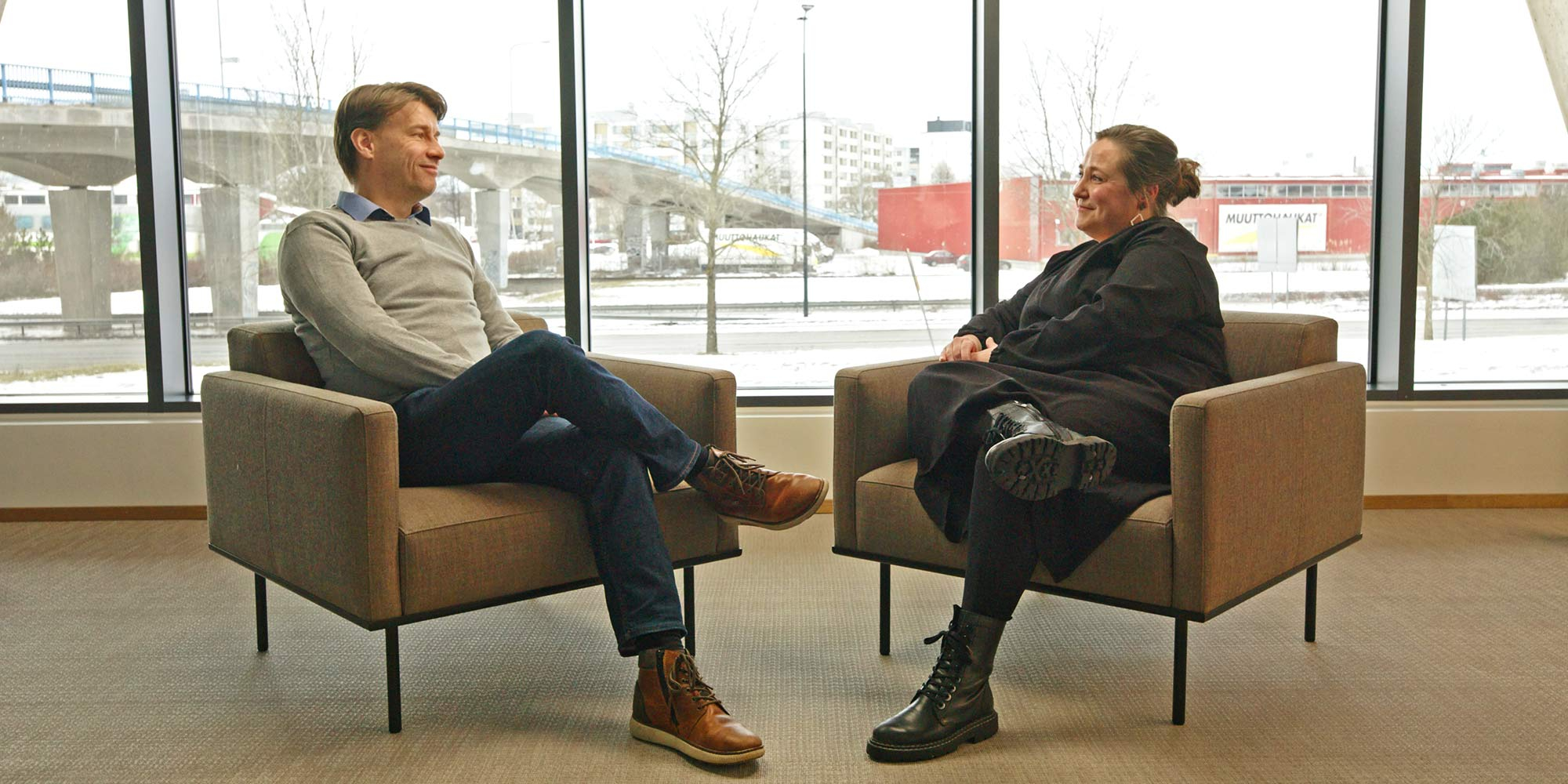
How do you design a building when there isn't even a local detailed plan yet? These were the starting points for InfraCity, realized in Itäharju, which is transforming into the Turku Science Park. Now, a video has been made about the design of InfraCity, known for hosting the premises of Turku Energia, in which the project's architects have their say. How did they think the project turned out, and would the architects themselves want to work in the building?
The first office building implemented by Teknologiakiinteistöt in Itäharju, InfraCity, has now been fully completed for nearly a year. The approximately 12,000-square-meter building was designed by architects Jani Vahala and Laura Puijola from Arkkitehtitoimisto Sarc + Sigge. Now that the dust has settled – or rather, cleared – it is a good time to ask the designers what the design project looks like in hindsight, and what kind of building we are leaving for future generations.
The goal of the design was to create a flexible, modern building in InfraCity that serves as a gateway to Turku and to the area transforming from an industrial zone into a Science Park. However, there was no desire to reinvent the wheel, and the building had to be implemented sensibly and cost-effectively.
“If you ask anyone on the street what an ugly building is like, quite a few will be able to say that it’s one of those concrete element buildings with a panel that has a window in the middle. And now we have a building that looks a bit like that, but maybe it’s not exactly the same thing. I see it as having tried to make an interesting and fine building from a starting point that is usually perceived as ugly,” Laura Puijola says in the video.
“If you ask anyone on the street what an ugly building is like, quite a few will be able to say that it’s one of those concrete element buildings with a panel that has a window in the middle.”
The aim was to make the interiors of InfraCity as people-friendly and comfortable as possible, and special attention was paid to good acoustics, which provides peace for work. Users were also considered when designing the shapes of the spaces.
“The spaces are easy to orient yourself in because every floor plan is very simple in its shape. There are no mazes, and you can see through from both ends, which means you always know where you are moving within the space,” says Jani Vahala.
In Puijola’s opinion, the best thing about InfraCity is the three-dimensional facade, which creates a distinctive look for the building in the cityscape. Vahala, on the other hand, particularly likes the spatial staircase that connects the building's third and fourth floors.
“The space has a grand sense of volume, and the large window surface further extends the space outside,” Vahala says.
The most essential part of the project's design, however, was sustainability, as construction uses many natural resources and always produces emissions. If a building is demolished after, say, 50 years, it is always a negative thing for the environment.
“I think it is important that when we build, we build properly and with a long-term perspective so that the buildings last and are easily adaptable. The more flexible buildings we construct, the longer-lasting they are,” concludes Puijola.